


The label printing industry is evolving rapidly. Digital and hybrid printing technologies are advancing, offering greater flexibility, faster turnaround times, and improved efficiency. This shift is being driven by shorter print runs, versioning, and increasing demand for customization.
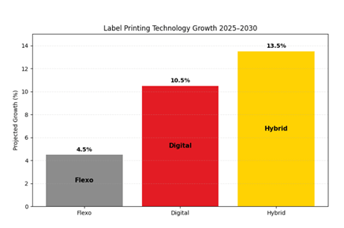
 Market forecasts support this trend. Digital label printing is expected to grow at approximately 10 to 11 percent annually through 2030, with hybrid platforms expanding even faster. However, there is a critical reality behind these growth numbers.
Flexographic printing remains the dominant production technology in the global label industry, and it continues to grow.
This is not a market being replaced. It is a market being reshaped. Flexo is evolving alongside digital, strengthening its role within a more integrated print environment.
Why Flexo Still Leads in Label Printing
Recent market data highlights both change and stability.
 The global flexographic press market is projected to grow from about $9.93 billion in 2025 to $12.49 billion by 2030, representing steady annual growth of 4 to 5 percent. At the same time, digital label and packaging printing is expected to grow from $22.0 billion to $36.9 billion.
While digital is growing faster, growth rate alone does not determine market leadership.
Flexo benefits from decades of installed equipment, proven workflows, and production efficiency at scale. It remains the backbone of high-volume label production across industries such as food and beverage, household goods, and logistics.
Digital and hybrid technologies are expanding, but they still represent a smaller share of total production volume.
Digital vs Flexo: Growth vs Production Reality
It is important to separate growth trends from production reality.
 Digital printing excels in areas that require flexibility. These include short runs, variable data, rapid design changes, and just-in-time production.
Hybrid printing combines digital flexibility with conventional print strength.
Flexo continues to dominate where consistency, speed, and cost efficiency matter most. In medium and long print runs, it delivers high-quality results at the lowest cost per unit.
This is not a competition where one technology replaces another. The industry is segmenting, with each technology serving the applications where it performs best.
Modern Flexo Technology Is More Advanced Than Ever
Flexographic printing is no longer a static process. It has evolved significantly in both quality and capability.
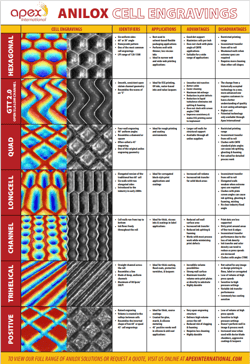 Extended Color Gamut printing reduces the need for spot colors while improving consistency across runs. Advances in plate technology, screening, and press control systems have narrowed the quality gap with digital printing.
Flexo is also expanding beyond ink transfer into high-value applications.
Innovations in anilox technology, including GTT engraving, allow for precise control of ink and coating volumes. This enables advanced embellishment techniques such as tactile coatings, gloss and matte contrasts, textured finishes, and functional coatings.
These capabilities are increasingly important as brands focus on shelf impact and product differentiation.
In many cases, flexo is not competing with digital. It is enhancing it.
Hybrid Printing: The Future of Integration
Hybrid printing represents the clearest direction for the industry.
Instead of replacing flexo, hybrid presses integrate it.
Modern systems combine digital print units with flexo stations for white ink, coatings, varnishes, and specialty applications. Digital delivers flexibility, while flexo provides performance and efficiency.
This combination allows converters to achieve both speed and versatility within a single production line.
Flexo is becoming the functional backbone of hybrid printing.
Cost Comparison: Flexo vs Digital Printing
Economics remain one of the most important factors in print technology selection.
|
Factor |
Flexo |
Digital |
|
Setup cost |
Higher |
Lower |
|
Cost per unit (long run) |
Very low |
Higher |
|
Break-even point |
More than 11,000 ft |
Less than 11,000 ft |
|
Speed |
Very high |
Increasing, but lower |
|
Waste |
Moderate |
Low |
|
Best use case |
Medium–long runs |
Short runs / variable data |
Flexo continues to lead in high-volume production because of its cost efficiency. As long as large-scale label production exists, flexo will remain essential.
Sustainability in Label Printing
 Sustainability is becoming a key focus across the industry.
Digital printing offers advantages in reducing waste and enabling on-demand production. At the same time, flexo is making strong progress.
Water-based inks, improved VOC management, and UV LED curing are reducing environmental impact. Process improvements and longer-lasting components are also increasing efficiency.
The gap between digital and flexo sustainability is narrowing.
The Future of Label Printing: Coexistence and Strategy
The future of label printing will not be defined by a single technology.
Flexo will continue to lead in high-volume production.
Digital will grow in areas that require flexibility and speed.
Hybrid will connect both technologies, creating new opportunities.
The most successful converters will not choose one over the other. They will use each technology strategically based on the application.
Conclusion: Flexo Remains the Foundation
Flexographic printing continues to be the foundation of the global label industry. It is growing, evolving, and delivering unmatched efficiency for large-scale production.
Digital and hybrid technologies are expanding and bringing new capabilities. Their growth strengthens the industry rather than replacing flexo.
For the foreseeable future, flexo remains a critical part of label printing.
It is adaptable, scalable, and built for what comes next.
Ready to improve your print performance? Contact our team to discuss your application and find the right anilox and cleaning solution for your operation.